 Ultimate guide
Emergency Plumbing Repair for Rental Properties: A Landlord's Guide
Last Updated: November 23, 2026
Quick Summary
Emergency plumbing repair for rental properties begins with one question: does the problem threaten health, safety, or the building's structure right now? If yes, it is an emergency requiring an immediate after-hours callout; if it can wait until morning without causing damage, it is not. Treating a habitability issue as routine maintenance can expose you to liability when running water or sanitation is compromised.
- Active flooding, gas smell, sewage backup, or no water at all means act now with an immediate after-hours callout.
- Slow leaks, a single fixture down, or weak pressure should be scheduled within 24-72 hours.
- Show every tenant the main shutoff at move-in and have them turn it once themselves.
- Give tenants a one-page shutoff card with a photo of the main valve and the after-hours number.
- In a true emergency, most leases allow entry without notice, but document the entry with a timestamp.
Table of Contents
- What Counts as Emergency Plumbing in a Rental Property
- Common Rental Plumbing Emergencies and First Steps
- How Tenants Should Shut Off the Water Supply
- Who Handles the Repair: Landlord and Tenant Responsibilities
- Emergency Plumbing Repair Response Time and After-Hours Protocol
- The Tenant Repair Request Template That Prevents Disputes
- Your Rental Property Plumbing Maintenance Checklist
- Insurance, Evidence, and Access Rules During an Emergency
- Getting an Upfront Estimate for Your Rental Property Repair
- Frequently Asked Questions
What Counts as Emergency Plumbing in a Rental Property
Emergency plumbing repair for rental properties starts with one question: does this problem threaten health, safety, or the structure of the building right now? If yes, it is an emergency. If it can wait until morning without causing damage, it is not.
The distinction matters because it decides who pays, how fast someone responds, and whether the tenant can legally demand immediate action. Landlords commonly overspend on problems that could have waited, and they can also underreact to a slow leak that quietly rots a subfloor. The second mistake costs far more.
Here is how to draw the line clearly.
Legal Habitability Standards vs. Maintenance Definitions
Habitability is the legal standard requiring a rental unit to remain safe and livable, covering essentials like running water, hot water, and working sanitation. Every state enforces some version of this, though the specifics vary.
A maintenance definition is narrower and practical: does the issue need a licensed plumber today, or can it go on a scheduled list? A dripping faucet is maintenance. A burst supply line flooding a hallway is habitability.
Watch out: treating a habitability issue as routine maintenance can expose a landlord to liability if the tenant documents the delay.
The Triage Flowchart: Act Now, Schedule Soon, or Log It
Use this decision path on every call:
| Signal | Category | Response Window |
|---|---|---|
| Active flooding, gas smell, sewage backup, no water at all | Act now | Immediate, after-hours callout |
| Slow leak, single fixture down, weak pressure | Schedule soon | Within 24-72 hours |
| Dripping faucet, running toilet, cosmetic issue | Log it | Next routine maintenance visit |
The flowchart is not a legal document. Local housing codes and your lease terms set the actual obligations, so confirm the specifics for your jurisdiction before relying on any triage rule.
Common Rental Plumbing Emergencies and First Steps
Rental properties produce a predictable set of crises. Knowing the first three moves for each one keeps a bad night from becoming a catastrophic month.
Replacing corroding or leaking pipes can be expensive, which is why fast first steps matter.
Burst Pipes and Supply Line Failures
Shut the water off first, then call. A burst supply line can dump hundreds of gallons before a plumber arrives, and every minute of flow adds to the damage. Tenants should know where the main valve is before they ever need it.
Sewer Backup, Gas Leaks, and Major Flooding
These three are the highest-severity calls a landlord takes.
- Sewer backup: stop water use immediately, keep tenants out of the affected area, and treat it as a health hazard.
- Gas leak: anyone who smells gas should leave the unit and call the gas utility from outside. No switches, no flames, no waiting.
- Major flooding: cut power to affected rooms if it is safe to reach the panel, then shut off the main.
If a pipe bursts at night, the immediate steps are the same whether it is 2 p.m. or 2 a.m. Our guide on what to do first when a pipe bursts at night walks through the sequence step by step.
How Tenants Should Shut Off the Water Supply
Every tenant should be shown the shutoff before a crisis. It is the single most useful two-minute orientation a landlord can give, and it is the difference between a towel and a demolished ceiling.
There are three levels of shutoff, and tenants need to know which one to reach for. Work from the smallest valve to the largest.
Level 1: The Fixture Valve
Most toilets and sinks have a small oval or lever valve on the supply line behind or beneath the fixture. Turn it clockwise until it stops. This stops water to that one fixture only, which is usually enough for a running toilet, a leaking supply tube, or a dripping faucet.
Watch out: fixture valves on older units are often corroded open and will not turn by hand. If the handle will not budge, do not force it with pliers, a snapped stem turns a small leak into an open pipe. Move to the next level instead.
Level 2: The Branch or Zone Valve
Larger buildings and some houses have zone valves that isolate a bathroom, a kitchen, or one floor. These are usually gate or ball valves on a pipe running to that zone, often behind an access panel. A ball valve has a lever that turns a quarter turn; a gate valve has a round wheel that takes several turns. Closing a zone valve stops water to every fixture on that branch, which is the right move when a leak is coming from a pipe inside a wall and you cannot tell which fixture feeds it.
Level 3: The Main Shutoff
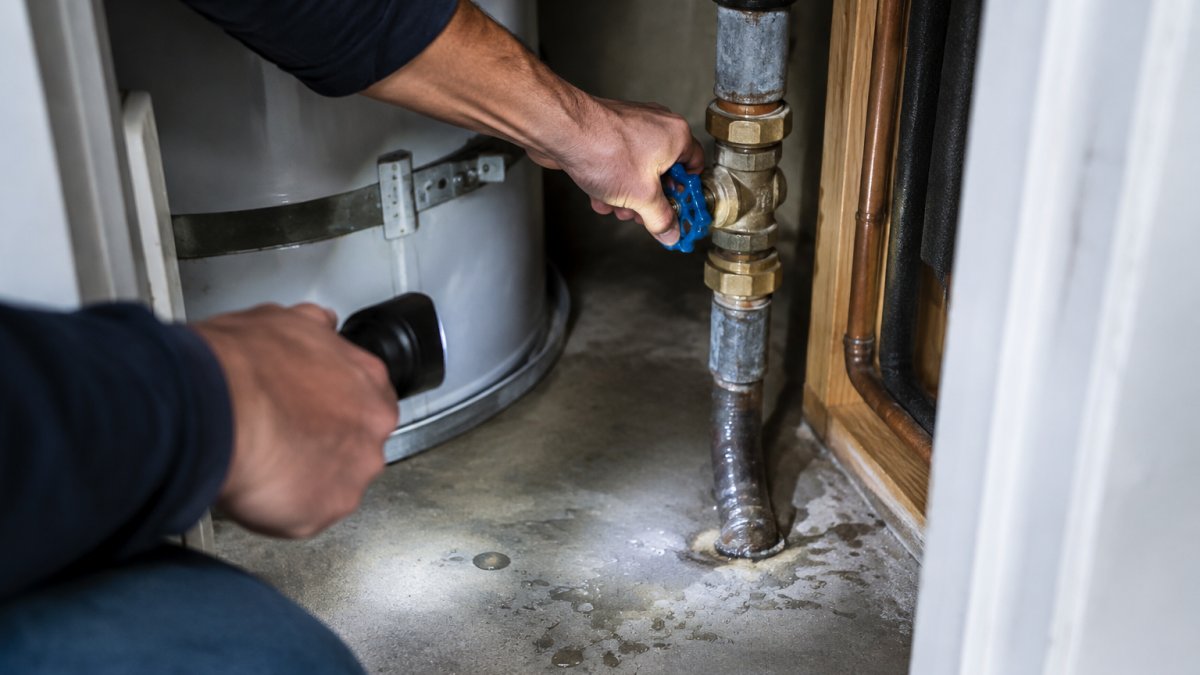
For a burst pipe or major leak, go to the main valve. It is typically near the water meter, in a utility closet, in a basement, or where the supply line enters the building. A ball valve turns a quarter turn; a gate valve takes several full turns. Turn it clockwise until it stops, then open a low faucet to confirm the flow has actually stopped.
What to Do When the Main Will Not Close
If the main valve is stuck, corroded, or will not stop the flow completely, the tenant should not keep forcing it. The next step is to call the landlord or the after-hours line and, if water is actively damaging the unit, call the water utility to shut off service at the meter. That call is faster than waiting for a plumber when a supply line has failed. Once the immediate water risk is contained, a triage checklist can help keep the landlord’s next emergency maintenance decisions focused on protecting the unit and arranging repairs.
Label It and Walk It
Label the main valve with a sticker and a one-line instruction. Better, walk every new tenant to the valve at move-in and have them turn it themselves once, with the water off, so they know the feel of it. A tenant who has operated the valve once will operate it correctly at 2 a.m. A tenant who has only read about it in a lease will hesitate.
Give tenants a one-page shutoff card at move-in: a photo of the main valve, its location, the direction to turn it, and the after-hours number. That card does more to limit water damage than any clause in the lease.
Who Handles the Repair: Landlord and Tenant Responsibilities
Most repair disputes come down to cause. Normal wear and tear is the landlord's responsibility. Damage the tenant caused, or failed to report in time, often shifts to the tenant.
Landlord obligations generally cover the plumbing system itself: supply lines, water heater, drains, and fixtures that fail through age. Tenant responsibilities usually cover reporting problems promptly, basic care, and any damage from misuse. Local housing laws and the lease control the actual split, and they vary by jurisdiction.
For a fuller breakdown of repair duties and emergency planning in commercial units, our property manager's guide to commercial plumbing maintenance covers inspection schedules and emergency plans in detail.
Emergency Plumbing Repair Response Time and After-Hours Protocol
Response time is where promises meet reality. A landlord needs a written protocol, not a vague assurance that someone will come.
Set expectations in three tiers: an immediate callout for active flooding or gas, a same-day window for urgent-but-contained issues, and a next-business-day slot for everything else. Put the after-hours number in the lease and in a welcome packet. Tenants who cannot reach anyone at 11 p.m. tend to call a lawyer instead.
Same-day service is realistic when the request is clear and the plumber is local. Our article on whether same-day plumbing is really possible explains what to expect from a genuine same-day response.
The Tenant Repair Request Template That Prevents Disputes
A written request protects both sides. It creates a timestamp, documents the problem, and shows the tenant reported it promptly.
Give tenants this template at move-in:
Repair Request Unit: ______ Date and time reported: ______ Location of problem: ______ What is happening: ______ When it started: ______ Photos attached: Yes / No Water shut off: Yes / No / Not applicable Best contact number: ______ Permission to enter if no one is home: Yes / No
Ask for photos with every request. A photo of a leak on day one is evidence; a description on day ten is an argument.
Your Rental Property Plumbing Maintenance Checklist
Prevention is cheaper than any emergency callout. A simple annual and seasonal routine catches most failures before they flood anything.
- Test the main shutoff valve every six months
- Inspect supply lines under sinks for corrosion or bulging
- Flush the water heater annually
- Check toilet flappers and running toilets
- Clear slow drains before they clog fully
- Inspect the water heater for rust or moisture
- Label the main valve and confirm tenants know its location
- Review the emergency contact list each season
A planned maintenance schedule is a budget decision as much as a safety one. For the full scope of what a maintenance program includes, see our breakdown of what plumbing maintenance for property management companies covers.
Insurance, Evidence, and Access Rules During an Emergency
Document everything, and know your entry rights before you use them. In a true emergency, most leases and state laws allow the landlord to enter without prior notice to stop damage, but "emergency" has a legal meaning and it is narrower than "inconvenient." A slow drip under a sink is not an emergency for entry purposes; an active supply-line failure that is flooding a unit is.
The Evidence Checklist
Photograph and keep, for every emergency callout:
- Wide shots of the affected room before any cleanup, then close-ups of the failure point
- A photo of the shutoff valve in its closed position, with a timestamp
- The tenant's written report and any photos they sent
- The plumber's invoice with the scope of work and parts listed
- Every text, email, and call log entry with the tenant and the contractor
- Receipts for any emergency mitigation, such as water extraction or fan rental
A photo of a leak on day one is evidence; a description on day ten is an argument. A clean timeline is easier to document and defend. Build that timeline as the event happens, not after.
How to Coordinate With Insurers
Report the loss to the property insurer promptly and ask whether the policy requires a specific mitigation step before a permanent repair. Many policies expect the landlord to prevent further damage, which is why the shutoff and the extraction happen first and the paperwork follows. Keep the emergency mitigation charges separate from the permanent repair charges on the invoice so each can be coded to the right coverage. Do not promise a tenant that insurance will cover a hotel stay or a rent abatement until the carrier has confirmed it.
Access Rules in an Emergency
Access rules vary by state and by lease. The common pattern is that a landlord may enter without prior notice when there is an imminent threat to health, safety, or the property, but must give notice for routine repairs. When in doubt, knock, announce, and document the entry with a timestamp and a note of what was found.
Watch out: treating a non-emergency as an emergency to skip notice can expose a landlord to a tenant complaint even when the repair was justified. If the issue can wait for a notice period, give the notice.
Keep the Paper Trail Together
Store the photos, invoices, messages, and entry notices in one folder per unit per incident. A single folder is what an adjuster or an attorney will ask for, and it is what turns a disputed claim into a paid one.
Getting an Upfront Estimate for Your Rental Property Repair
Get the estimate in writing before work starts, and get more than one. A written estimate should list the scope of work, the parts, and the total, so there are no surprises once the plumber is under the sink.
Resolution Plumbing gives upfront pricing with no hidden fees, and we tell customers plainly what does not need doing right now. A plumber with 20 years of experience across many job types learns that the honest answer is often "that can wait." Our explanation of why upfront pricing matters for plumbing repairs covers how to compare quotes and avoid surprise charges.
A rental plumbing emergency tests your systems as much as your pipes. The landlords who come through it with minimal damage are the ones who planned the response before they needed it. Resolution Plumbing is a family-owned, fully licensed and insured team (License #0086893) serving rental property owners with same-day appointments, emergency service, and clear upfront pricing.
Frequently Asked Questions
Who is responsible for plumbing repairs in a rental property?
The landlord is generally responsible for repairs needed to keep the unit habitable, including the plumbing system and supply lines. Tenants are typically responsible for damage they cause through misuse, such as flushing wipes that clog a drain. Written lease terms and state law decide the edges. Resolve disputes with photos, records, and a written repair request rather than a phone call, and get estimates before authorizing any work.
How quickly should a landlord respond to an emergency plumbing repair request?
Treat active flooding, a burst pipe, a gas leak, or a sewer backup as same-hour issues: instruct the tenant to shut off the water and dispatch a licensed plumber. Many plumbing calls are urgent, so after-hours coverage matters. Confirm a response window in writing and tell the tenant who is coming and when. Document the call, the dispatch time, and the repair.
Should a tenant call a plumber directly during an emergency?
The lease should say. Most leases require the tenant to notify the landlord or property manager first and to shut off the water if it is safe. Direct-dispatch clauses usually cap what a tenant can spend without approval. Give tenants a written emergency contact and a clear instruction: stop the water, then call. Keep a copy in the unit so it is available after hours.
Does a landlord have to pay for temporary lodging during plumbing repairs?
It depends on state law and how long the unit is uninhabitable. If a working toilet, water, or hot water is unavailable for an extended period, some states require the landlord to provide alternative housing or reduce rent. Check your state's habitability statute and your lease before promising anything. Document the outage dates, the repair timeline, and every communication with the tenant.
How much does emergency plumbing repair cost for a rental property?
Pricing depends on the failure, access, parts, and time of day, so ask for an upfront estimate before work begins. Replacing corroding or leaking pipes can be costly, which shows why prevention matters. Budget for emergencies annually and keep a reserve. Resolution Plumbing publishes pricing on its website and gives estimates before starting.
What should a tenant include in a plumbing repair request?
Photos and video of the leak or blockage, the fixture affected, whether water is still running, and whether the shutoff valve worked. Add the time the problem started, any prior repairs, and a phone number for callback. A written request creates a record for the landlord, the insurer, and any later dispute. Use a simple template so nothing is missed and every report is comparable.